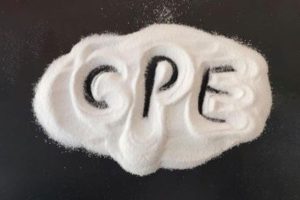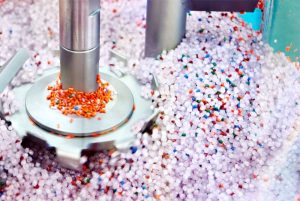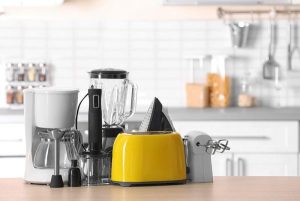
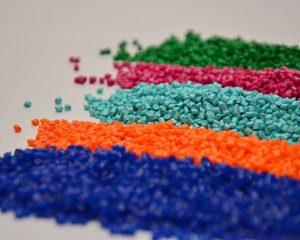
Polypropylene compounds are thermoplastic resins produced by blending one or more base polyolefins with various functional components such as impact modifiers, fillers and reinforcements, pigments, and additives. These PP compounds offer a broad spectrum of properties and are widely used in automotive, electrical appliances, building and construction, and furniture components.
Structure and Behavior of Polypropylene Compounds
Polypropylene compound shares similarities with polyethylene, particularly in solution behavior and electrical characteristics. However, the presence of methyl groups in polypropylene enhances its mechanical strength and thermal resistance, albeit at the expense of reduced chemical resistance. In isotactic polypropylene, the methyl groups are aligned on one side of the carbon backbone, resulting in higher crystallinity. This configuration makes it firmer and more resistant to creep compared to atactic polypropylene and polyethylene.
Introduction to Polypropylene (PP)
Polypropylene (PP) belongs to the polyolefin family and is among the three most widely used thermoplastics globally. PP compounds are utilized across many applications, such as:
Automotive industry
Industrial applications
Consumer goods
Furniture and household products
One notable advantage of PP is its low density, the lowest among commodity plastics.
Polypropylene Polymer Structures
Based on the spatial arrangement of methyl groups (CH₃) on the polymer chain, polypropylene is classified into:
Atactic PP: Irregular methyl group arrangement
Isotactic PP: Methyl groups aligned on one side of the chain
Syndiotactic PP: Alternating methyl group arrangement
Types of Polypropylene Compounds
1. Homopolymer Polypropylene
This is the most commonly used grade and consists of only propylene monomers. It has a semi-crystalline structure and is widely used in:
Packaging
Textiles
Healthcare products
Piping systems
Automotive parts
Electrical insulation
2. Copolymer Polypropylene
There are two main subtypes of copolymers:
Random Copolymer PP: Produced by copolymerizing ethylene and propylene, with ethylene units randomly distributed (up to 6%). These PP compounds are flexible and optically transparent, ideal for transparent applications or products requiring aesthetic appeal.
Block Copolymer PP: Contains a higher ethylene content (5–15%) arranged in regular blocks. These compounds offer higher strength but are less flexible, making them suitable for structural and industrial uses.
PP copolymers are commonly used in:
Packaging
Home appliances
Pipes and films
Electrical components
Automotive applications requiring impact resistance
3. Terpolymer Polypropylene
Terpolymers consist of propylene, ethylene, and butene units randomly distributed along the chain. These poly propylene compounds exhibit enhanced clarity and reduced crystallinity, making them ideal for sealing films and transparent packaging.
4. High Melt Strength Polypropylene (HMS PP)
HMS PP is modified to include long-chain branching, offering high melt strength and melt phase elasticity. These PP compounds feature:
Excellent foamability
Good chemical resistance
High thermal stability
They are widely used in:
Food packaging foams
Automotive components
Construction materials
Disadvantages of Polypropylene Compounds
Despite its versatility, polypropylene compound has several limitations:
Poor resistance to UV radiation, impact, and scratches
Limited service temperature range (90–120°C)
Tendency to swell in chlorinated and oxidizing environments
Poor paint and coating adhesion
Applications of Polypropylene Compounds
1. Packaging
Polypropylene is widely used in packaging due to its high strength, low cost, and moisture barrier properties. It is ideal for:
Food packaging (films, containers, shrink wraps)
Electronic and graphic films
Disposable closures (e.g., diaper tabs)
Cast and BOPP (biaxially oriented polypropylene) films
2. Consumer Goods
PP compounds are used in:
Transparent containers
Appliances and household items
Toys and suitcases
Furniture components
3. Automotive Industry
Thanks to its cost-effectiveness, moldability, and mechanical performance, PP is essential for:
Bumpers
Fender liners
Battery casings
Door trims
Interior panels
Key properties include:
Low thermal expansion
Lightweight
Chemical and weather resistance
Excellent impact-to-stiffness balance
4. Fibers and Fabrics
PP is a dominant material in nonwoven and woven fabrics:
Ropes and tapes
Spunbond and meltblown fabrics
Textile fibers for industrial and marine uses
5. Medical Applications
Thanks to its biocompatibility and chemical resistance, medical-grade PP is used for:
Disposable syringes
Petri dishes and lab containers
IV bottles and medical vials
Food-grade trays and containers
6. Industrial Uses
PP sheets and components are used for:
Chemical tanks
Industrial pipes
RTP (Returnable Transport Packaging)
Corrosive-resistant liners
7. Biaxially Oriented Polypropylene (BOPP) Film
BOPP is stretched in both directions for better:
Strength and clarity
Tear resistance
Gloss and moisture barrier
Dimensional stability
Processing Guidelines for PP Compounds
PP can be processed using most standard thermoplastic methods:
Injection Molding
Melt temperature: 200–300°C
Mold temperature: 10–80°C
Drying: Not required under normal storage
High mold temperature enhances surface finish
Shrinkage rate: 1.5–3% (depending on thickness and conditions)
Extrusion
Used for pipes, films, cables, etc.
Melt temperature: 200–300°C
Compression ratio: 3:1
Barrel temperature: 180–205°C
Other Processing Methods
Compression molding
Rotational molding
Blow molding
Extrusion blow molding
Injection stretch blow molding